Overview
MatEnsemble is a framework to build, orchestrate, and asynchronously manage scalable adaptive-learning workflows, especially targeted for compute-intensive AI-driven materials modeling simulations (e.g., atomistic modeling, Phase-Field, etc.) as efficiently as possible. Apart from standard automated high-throughput computations, the core of MatEnsemble is designed to support “user-defined” acquisition strategies to dynamically steer workflows based on intermediate results, which is a common pattern in active learning and other autonomous workflows at scale. To enable scalable parametric sweeps and bypass standard scheduler bottlenecks, typically encountered in leadership computing platforms, MatEnsemble uses a single large allocation and an internal scheduler to manage arbitrarily large workloads. The library is built on top of the Flux resource manager, and implements an efficient and user-defined-strategy based task orchestration protocol, making it well-suited for high-throughput autonomous computing scenarios.
MatEnsemble [bagchi2025matensemble] benefits from the native Python executor interface of Flux [ahn2020flux],
and the concurrent asynchronous programming model of core Python through concurrent.futures objects [quinlan2009futures].
High-throughput orchestration and schedulers
The library targets high-throughput and ensemble scenarios: thousands of short bursts of simulations, parameter sweeps, or analysis pipelines where classic “one Slurm job per task” workflows would overwhelm the scheduler or spend too much time queued. In the context of high-throughput materials modeling, fully leveraging exascale resource capabilities with SLURM or similar schedulers is challenging due to:
Many short
sbatch/sruninvocations increasing scheduler load and log volume.Queue latency dominating when tasks are tiny relative to scheduler quanta.
Some centers capping how many job steps may be launched inside a single allocation.
Significant throughput loss due to idle resources and lack of fine-grained task management.
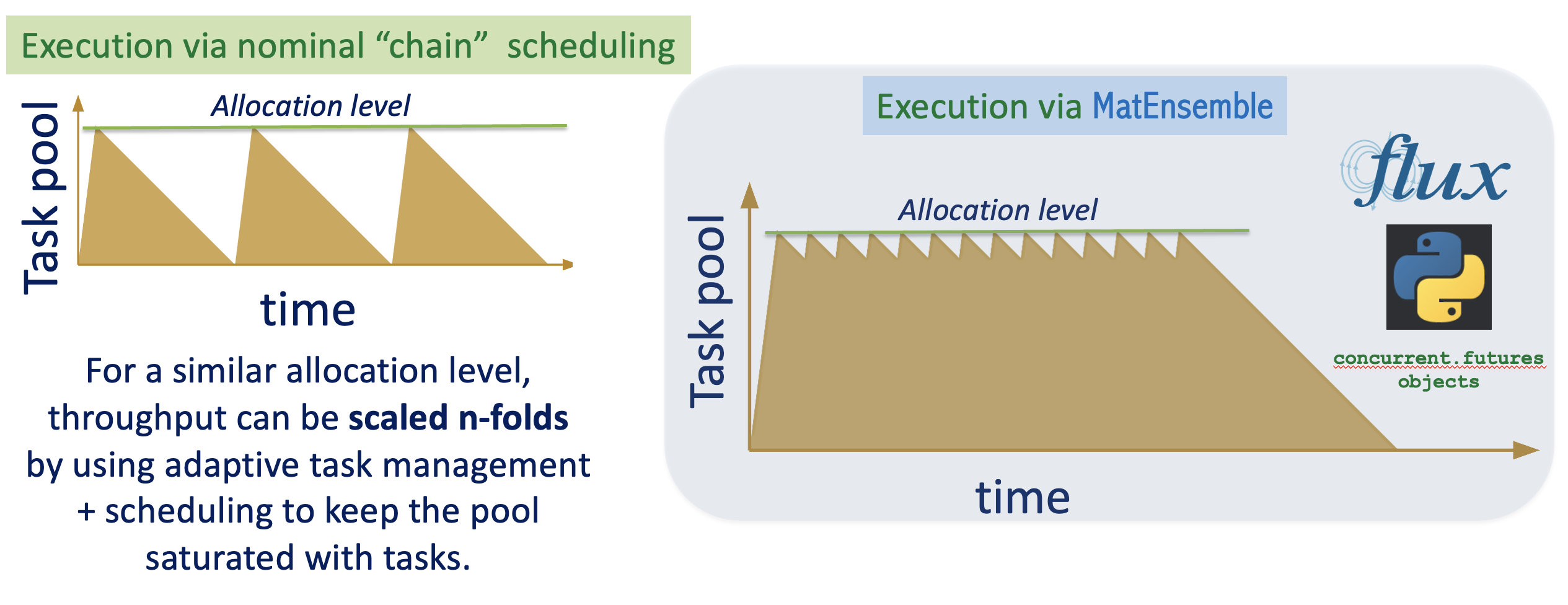
A common mitigation is one large allocation plus an internal scheduler that launches many child processes or MPI ranks inside that allocation. The remaining problem is utilization: if work is launched in static waves, fast tasks finish early and cores sit idle while slow tasks run. MatEnsemble addresses this with its adaptive task orchestration capability — new/pending tasks are launched as soon as resources free up, keeping the allocation saturated until all work is done.
What MatEnsemble does
MatEnsemble continuously: (1) tracks available computing resources, (2) submits ready DAG nodes to the queue, (3) processes completed Flux jobs, (4) unblocks dependents, and (5) repeats until no ready, running, or blocked work remains, and/or spawns new DAGs depending on user-defined strategies.
See Design and execution model for the exact loop, artifacts, and environment assumptions.
Core concepts
PipelineUser-facing builder. Decorated Python functions turn into delayed function calls;
exec()adds argv-style work.OutputReferencePlaceholder returned from a delayed function call. Passing it into another chore encodes a dependency edge and ensures upstream results are unpickled before the downstream function runs.
ChoreSingle Flux submission record — command, resources, working directory, and (for Python chores) pointers back to the source module.
FluxManagerRuntime coordinator created when
submit()is called.FutureProcessingStrategyPluggable completion handler. Built-ins:
AdaptiveStrategy(fill idle resources as tasks finish) andNonAdaptiveStrategy(wave-style drain).
Logging and on-disk layout
Every run creates a timestamped workflow directory under your chosen base path (by default the current working directory):
<base>/
└── matensemble_workflow-YYYYMMDD_HHMMSS/
    ├── status.json              # atomically updated for the dashboard / monitoring
    ├── matensemble_workflow.log # detailed text log from the ``matensemble`` logger
    └── out/
        ├── registry/            # pickled chore callables
        │   ├── Callable name
        │   ├── Callable name
        │   └── ...
        └── <chore_id>/
            ├── stdout
            ├── stderr
            ├── chore.pickle     # pickled chore object
            ├── metadata.json    # metadata of the chore in JSON for debugging
            └── result.pickle    # Python chore return value (pickle)
The driver prints a short hint to stderr with absolute paths to status.json, the log file, and the out
tree when logging initializes.
Adaptive vs. non-adaptive scheduling
In adaptive mode (the default), completing a chore can immediately trigger more submissions in the same
super-loop iteration via _submit_until_ooresources(), keeping the
allocation saturated when a backlog exists.
In non-adaptive mode, the manager only submits during the initial “fill until out of resources” phases; completion handling updates the DAG but does not proactively pull additional ready chores until the next outer-loop scheduling opportunity — use this when tighter control or simpler resource snapshots are desired.
User-defined strategies
MatEnsemble uses the strategy pattern when processing flux.job.FluxExecutorFuture completions:
class FutureProcessingStrategy(ABC):
    @abstractmethod
    def process_futures(self, buffer_time) -> None:
        ...
Users can define their own strategies and inject them into the processing loop. For example, a strategy can
inspect the result of a completed Chore, create one or more new
ChoreSpec objects, and add those chores to the submission queue while the workflow
is still running.
Roadmap and stability
Note
The project is under active development; pre-1.0 APIs may still move. Track CHANGELOG / release notes
in the repository for breaking changes. The internal dynopro package (streaming dynamics and heavy
analysis) ships in-tree but is not yet part of the curated Sphinx API toctree.
Checkpointing: write_restart_freq exists on submit(), but
checkpoint serialization is not yet implemented. Long production runs should pass None until
restart files are supported (Configuration and behavior reference).
References
Ahn, D. H., Bass, N., Chu, A., Garlick, J., Grondona, M., Herbein, S., Ingolfsson, H. I., Koning, J., Patki, T., Scogland, T. R. W., Springmeyer, B., and Taufer, M. (2020). “Flux: Overcoming scheduling challenges for exascale workflows.” Future Generation Computer Systems, 110, 202-213. https://doi.org/10.1016/j.future.2020.04.006
Quinlan, B. (2009). “PEP 3148 – futures - execute computations asynchronously.” Python Enhancement Proposals. https://peps.python.org/pep-3148/
Bagchi, S., Biswas, A., Balachandran, P. V., Ghosh, A., and Ganesh, P. (2025). “Towards ‘on-demand’ van der Waals epitaxy with an adaptive resource-driven online ensemble sampling simulation framework.” arXiv:2504.05539. https://doi.org/10.48550/arXiv.2504.05539
Next steps
Installation — containers, PyPI install, site-specific shell snippets.
Tutorials — minimal Python and executable examples, dependency graphs, packaging tips.
Design and execution model — Flux interactions,
PYTHONPATH, failure propagation, dashboard tunneling.Configuration and behavior reference — exhaustive parameter and artifact listing.
api-reference — docstring-generated module documentation.